

What's News
- September 27, 2024
- Research Fellow Dr. Touma Adachi has been selected as a JSPS Research Fellow (PD) for 2025.
- July 25, 2024
- PhD student Kyoka Suyama presented a poster titled "A detailed exploration of the progeny cell types produced by cerebellar Bergmann glia like progenitor" and Master's student Minami Mizuno presented "Exploring the function of transcription factor MEIS1 in cerebellar glial cell development" at Neuro2024.
- July 24, 2024
- Research Fellow Dr. Touma Adachi gave an oral presentation titled "Molecular Mechanisms Regulating Bergmann gliogenesis and Astrogliogenesis in Cerebellum" at Neuro2024.
- July 1, 2024
- Research Fellow Dr. Touma Adachi has been selected for a Medical Research Grant from the Takeda Science Foundation.
- March 1, 2024
- Research Fellow Dr. Touma Adachi received the Outstanding Poster Presentation Award at the 2023 National Institute of Neuroscience Internal Symposium.
- December 2, 2023
- Research Fellow Dr. Touma Adachi gave an oral presentation titled "Studies on the mechanism of astroglial cell fate determination during cerebellar development" at the 46th Japan Society for Neuronal Tissue Culture.
- November 12, 2023
- Research Fellow Dr. Touma Adachi presented a poster titled "Functional elucidation of the transcription factor MEIS1 during fate determination of cerebellar astroglial cells" at Society for Neuroscience 2023.
- October 24, 2023
- Research Fellow Dr. Touma Adachi gave an oral presentation at the AI Research Group Meeting.
- October 19, 2023
- Research Fellow Dr. Touma Adachi gave an oral presentation at the Genome Editing Research Group Meeting.
- September 22, 2023
- Research Fellow Dr. Touma Adachi gave an oral presentation at the NCNP Young Researchers' Meeting.
- August 2, 2023
- Research Fellow Dr. Touma Adachi presented a poster titled "Functional analysis of transcription factor MEIS1 in cerebellar astroglial cell development" at the 46th Annual Meeting of the Japan Neuroscience Society.
- June 21, 2023
- Research Fellow Dr. Touma Adachi gave an invited oral presentation (YIC) titled "Function of transcription factor Meis1 in the differentiation of Bergmann glia from astroglial progenitor" at The Asian Pacific Society for Neurochemistry APSN 2023.
- April 1, 2023
- Research Fellow Dr. Touma Adachi has been awarded a JSPS Grant-in-Aid for Early-Career Scientists (23K14203) for the project "Exploring the shared molecular basis and biological significance of two-step neurogenesis in the cerebellum and cerebral cortex."
- Ji Kaiyuan (1st year PhD student, Institute of Science Tokyo) and Minami Mizuno (4th year undergraduate, Kitasato University) have joined the research team this year.
- March 31, 2023
- Kentaro Ichijo, a 4th year PhD student at the University of Tokyo, received his doctoral degree for his thesis "Functional analysis of the transcription factor MEIS1 in the development of cerebellar Bergmann glia."
- March 10, 2023
- Research Fellow Dr. Touma Adachi gave an oral presentation titled "Functional analysis of the transcription factor MEIS1 in the development of cerebellar astroglial cells" at the 16th Symposium on Neural Development.
- February 21, 2023
- Research Fellow Dr. Touma Adachi has been selected for the "37th Research Exchange Grant" from the Kanahara Ichiro Memorial Foundation for Medical and Healthcare Promotion.
- January 10, 2023
- Research Fellow Dr. Touma Adachi has been selected as a Young Investigator Colloquiums (YIC) speaker at The Asian Pacific Society for Neurochemistry APSN 2023.
Research Overview
Understanding how the brain is formed leads to understanding how we acquire intelligence and how its function can be disrupted, leading to disease. However, many mysteries remain regarding the detailed mechanisms by which the brain, with its complex and elaborate structure and function, is constructed and maintained.
To answer these questions, we conduct research aimed at elucidating the molecular and cell biological basis of brain development, focusing primarily on the cerebellum.
The brain contains a diverse variety of neurons, each present in the appropriate number, forming the foundation that supports normal brain function. However, the mechanisms by which "(A) diverse types of neurons and glial cells are differentially generated from limited genetic information" and "(B) the appropriate number of each type of neuron and glial cell is generated at the appropriate timing" remain largely unknown. We have been addressing these important neuroscientific questions using the mouse cerebellum as a model system. Regarding (A), we have reported the elucidation of the functions of key transcription factors (PTF1A, ATOH1) that differentially generate inhibitory and excitatory neurons (Neuron 2005, J. Neurosci 2007, Development 2009, J. Neurosci 2014, Cell Rep 2018), and the mechanism by which transcription factors (OLIG2, GSX1) differentially generate Purkinje cells and interneurons (both inhibitory neurons) (Nature Communications 2014). Regarding "(B) the mechanism for generating the appropriate number of each neuronal type at the appropriate timing," we have begun to clarify part of the mechanism using cerebellar granule cell progenitors (GCPs) and their differentiation into granule cells (GCs) as a model system (J. Neurosci 2018, EMBO J 2021, eNeuro 2021).
We will continue to conduct research to answer the questions (A) and (B) outlined above. Below we describe some of what we have learned so far and the research we are currently conducting.
1. Elucidating the function of transcription factor MEIS1 in cerebellar development
Myeloid ecotropic viral integration site 1 (MEIS1) is a homeodomain transcription factor known to be expressed in various tissues and some tumors from development through adulthood. MEIS1 shows strong expression in the central nervous system, particularly in the cerebellar cortex. We previously discovered that cerebellar granule cell-specific deletion of MEIS1 severely impairs cerebellar formation, and demonstrated that this phenomenon results from disruption of MEIS1-mediated regulation of cerebellar granule cell progenitor differentiation via transcription factor PAX6 and BMP signaling (Fig. 1, J. Neurosci 2018).
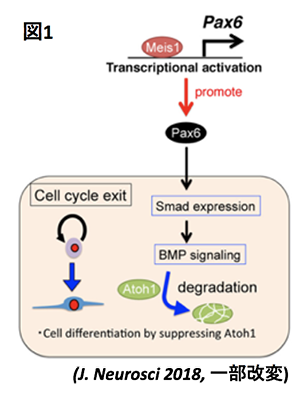
Although the above research represents the world's first detailed elucidation of MEIS1 function in the central nervous system, many aspects of transcription factor MEIS1 function in cerebellar development remain unknown.
We are currently investigating "the function of MEIS1 in cerebellar development beyond granule cells" and "research on developmental disorders caused by disruption of this function," primarily using mouse models, molecular biological and biochemical approaches, and bioinformatic analyses. We are also exploring "the distinct functions of individual MEIS1 isoforms" (https://doi.org/10.1101/2022.08.17.504235).
Through these studies, we hope to comprehensively elucidate the functions of MEIS1 in the central nervous system.
2. Elucidating the mechanisms controlling the timing of proliferation and differentiation in cerebellar granule cell progenitors
The cerebellum has long been considered important for motor function control, but research over the past decade has begun to report its involvement in higher functions such as social behavior and reward systems. Furthermore, like the cerebral cortex, the cerebellar cortex is a brain region that has expanded in cortical structure as evolution progressed toward primates.
Cerebellar volume increases almost proportionally with the number of cerebellar granule cells, and cerebellar granule cells have significantly increased in number in primates.
Since cerebellar granule cells have explosively increased in number during evolution, it has been predicted that a two-step neurogenesis mechanism involving secondary and tertiary proliferative neural progenitors, similar to the cerebral cortex, might exist, but its existence had not been clarified until recently.
In our previous research, we reported that there are two types of cerebellar granule cell progenitors (GCPs) in the mouse cerebellum: "undifferentiated ATOH1-positive GCPs (AT+GCPs)" and "slightly differentiated NEUROD1-positive GCPs (ND+GCPs)," and that AT+GCPs gradually transition to ND+GCPs during cerebellar development (AT-ND Transition) (EMBO J 2021). We also demonstrated that this AT-ND Transition is regulated by intercellular communication via Notch signaling between cerebellar granule cell progenitors (Fig. 2, eNeuro 2021).
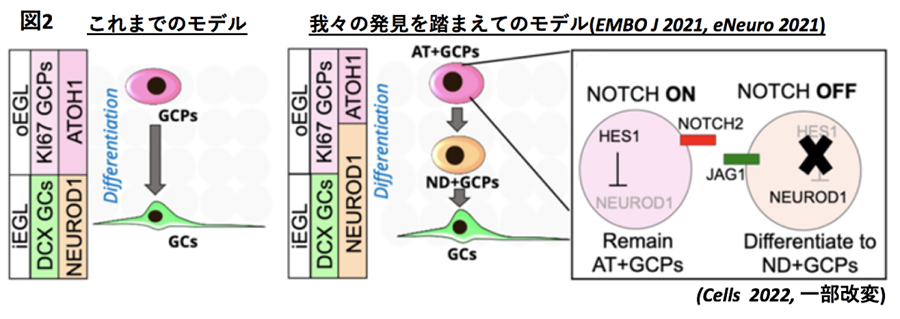
Interestingly, ND+GCPs do not exist in reptiles or birds and are a cell type acquired in mammals. Based on these studies, we are currently investigating the behavior of each type of GCP during division and differentiation, as well as the evolutionary significance of the acquisition of ND+GCPs.
Publications
- Owa T, Shiraishi R, Adachi A, Miyashita S, Ichijo K, Nishioka T, Taya S, Kaibuchi K, Hoshino M. Homeodomain-less MEIS1 suppresses CUL3-dependent ATOH1 degradation to regulate cerebellar granule cell development. Biorxiv 2022. doi:10.1101/2022.08.17.504235
- Miyashita S, Hoshino M. Transit amplifying progenitors in the cerebellum: Similarities to and differences from transit amplifying cells in other brain regions and between species. Cells. 2022 Feb 18;11(4): 726. doi: 10.3390/cells11040726.
- Miyashita S, Owa T, Seto Y, Yamashita M, Aida S, Sone M, Ichijo K, Nishioka T, Kaibuchi K, Kawaguchi Y, Taya S, Hoshino M. Cyclin D1 controls development of cerebellar granule cell progenitors through phosphorylation and stabilization of ATOH1. EMBOJ 2021 Jul 15; 40(14): e105712. doi: 10.15252/emboj.2020105712.
- Adachi T, Miyashita S, Yamashita M, Shimoda M, Okonechnikov K, Chavez L, Kool M, Pfister SM, Inoue T, Kawauchi D, Hoshino M. Notch Signaling between Cerebellar Granule Cell Progenitors. eNeuro. 2021:ENEURO.0468-20.
- Yamashita M, Owa T, Shiraishi R, Adachi T, Ichijo K, Taya S, Miyashita S, Hoshino M. The role of SCFSkp2 and SCFβ-TrCP1/2 in the cerebellar granule cell precursors. Genes to Cells. 2020 Oct 6. doi: 10.1111/gtc.12813.
- Shiraishi RD, Miyashita S, Yamashita M, Adachi T, Shimoda MM, Owa T, Hoshino M. Expression of transcription factors and signaling molecules in the cerebellar granule cell development. Gene Expr Patterns. 2019 Dec;34:119068. doi: 10.1016/j.gep.2019.119068. Epub 2019 Aug 20. PMID: 31437514
- Fujiyama T, Miyashita S, Tsuneoka Y, Kanemaru K, Kakizaki M, Kanno S, Ishikawa Y, Yamashita M, Owa T, Nagaoka M, Kawaguchi Y, Yanagawa Y, Magnuson MA, Marutani M, Shibuya A, Nabeshima Y, Yanagisawa M, Funato H and Hoshino M. Forebrain Ptf1a is required for sexual differentiation of the brain. Cell Rep., 2018 July 3; 24(1):79-94. doi:10.1016/j.celrep.2018.06.010
- Owa T, Taya S, Miyashita S, Yamashita M, Adachi T, Yamada K, Yokoyama M, Aida S, Nishioka T, Inoue YU, Goitsuka R, Nakamura T, Inoue T, Kaibuchi K, Hoshino M: Meis1 Coordinates Cerebellar Granule Cell Development by Regulating Pax6 Transcription, BMP Signaling and Atoh1 Degradation. J Neurosci, 2018 Jan 31;38(5):1277-1294. doi: 10.1523/JNEUROSCI.1545-17.2017. Epub 2018 Jan 9.
- Miyashita S*, Adachi T*, Yamashita M, Sota T, Hoshino M: Dynamics of the cell division orientation of granule cell precursors during cerebellar development. Mech Dev, 2017 Oct;147:1-7. doi: 10.1016/j.mod.2017.06.002. Epub 2017 Jun 17. *These authors contributed equally.
- Hashimoto R, Hori K, Owa T, Miyashita S, Dewa K, Masuyama N, Sakai K, Hayase Y, Seto Y, Inoue YU, Inoue T, Ichinohe N, Kawaguchi Y, Akiyama H, Koizumi S, Hoshino M: Origins of oligodendrocytes in the cerebellum, whose development is controlled by the transcription factor, Sox9. Mech Dev, May;140:25-40. doi: 10.1016/j.mod.2016.02.004. Epub 2016 Mar 3.
- Leto K, Arancillo M, Becker EB, Buffo A, Chiang C, Ding B, Dobyns WB, Dusart I, Haldipur P, Hatten ME, Hoshino M, Joyner AL, Kano M, Kilpatrick DL, Koibuchi N, Marino S, Martinez S, Millen KJ, Millner TO, Miyata T, Parmigiani E, Schilling K, Sekerková G, Sillitoe RV, Sotelo C, Uesaka N, Wefers A, Wingate RJ, Hawke: Consensus paper: cerebellar development. Cerebellum, 2016 Dec;15(6):789-828. Review.
- De Luca A, Parmigiani E, Tosatto G, Martire S, Hoshino M, Buffo A, Leto K, Rossi F: Exogenous Sonic Hedgehog modulates the pool of GABAergic interneurons during cerebellar development. Cerebellum, 14, 72-85, 2015.
- Seto Y, Nakatani T, Masuyama N, Taya S, Kumai M, Minaki Y, Hamaguchi A, Inoue YU, Inoue T, Miyashita S, Fujiyama T, Yamada M, Chapman H, Campbell KJ, Magnuson MA, Wright CV, Kawaguchi Y, Ikenaka K, Takebayashi H, Ishiwata S, Ono Y, Hoshino M: Temporal identity transition from Purkinje cell progenitors to GABAergic interneuron progenitors in the cerebellum. Nature Communications, 5, 3337, 2014.
- Yamada M, Seto Y, Taya S, Owa T, Inoue YU, Inoue T, Kawaguchi Y, Nabeshima Y, Hoshino M. Specification of spatial identities of cerebellar neuronal progenitors by Ptf1a and Atoh1 for proper production of GABAergic and glutamatergic neurons. J. Neurosci, 34, 4786-4800, 2014.
- Seto Y, Ishiwata S, Hoshino M: Characterization of Olig2 expression during cerebellar development. Gene Expression Patterns, 15, 1-7, 2014.
- Kawauchi T, Sekine K, Shikanai M, Chihama K, Tomita K, Nakajima K, Nabeshima Y, Hoshino M: Rab GTPases-dependent endocytic pathways regulate neuronal migration and maturation through N-Cadherin trafficking. Neuron, 67, 588-602, 2010.
- Fujiyama T, Yamada M, Terao M, Terashima T, Hioki H, Inoue YU, Inoue T, Masuyama N, Obata K, Yanagawa Y, Kawaguchi Y, Nabeshima Y, Hoshino M: Inhibitory and excitatory subtypes of cochlear nucleus neurons are defined by distinct bHLH transcription factors, Ptf1a and Atoh1. Development, 136, 2049-2058, 2009.
- Yamada M, Terao M, Terashima T, Fujiyama T, Kawaguchi Y, Nabeshima Y, Hoshino M: Origin of climbing fiber neurons and their developmental dependence on Ptf1a. J. Neurosci., 27, 10924-10934, 2007.
- Kawauchi T, Chihama K, Nabeshima Y, Hoshino M: Cdk5 phosphorylates and stabilizes p27kip1, contributing to actin organization and cortical neuronal migration. Nature Cell Biol. 8, 17-26, 2006.
- Hoshino M, Nakamura S, Mori K, Kawauchi T, Terao M, Nishimura YV, Fukuda A, Fuse T, Matsuo N, Sone M, Watanabe M, Bito H, Terashima T, Wright CVE, Kawaguchi Y, Nakao K, Nabeshima Y: Ptf1a, a bHLH transcriptional gene, defines GABAergic neuronal fates in cerebellum. Neuron, 47, 201-213, 2005.
